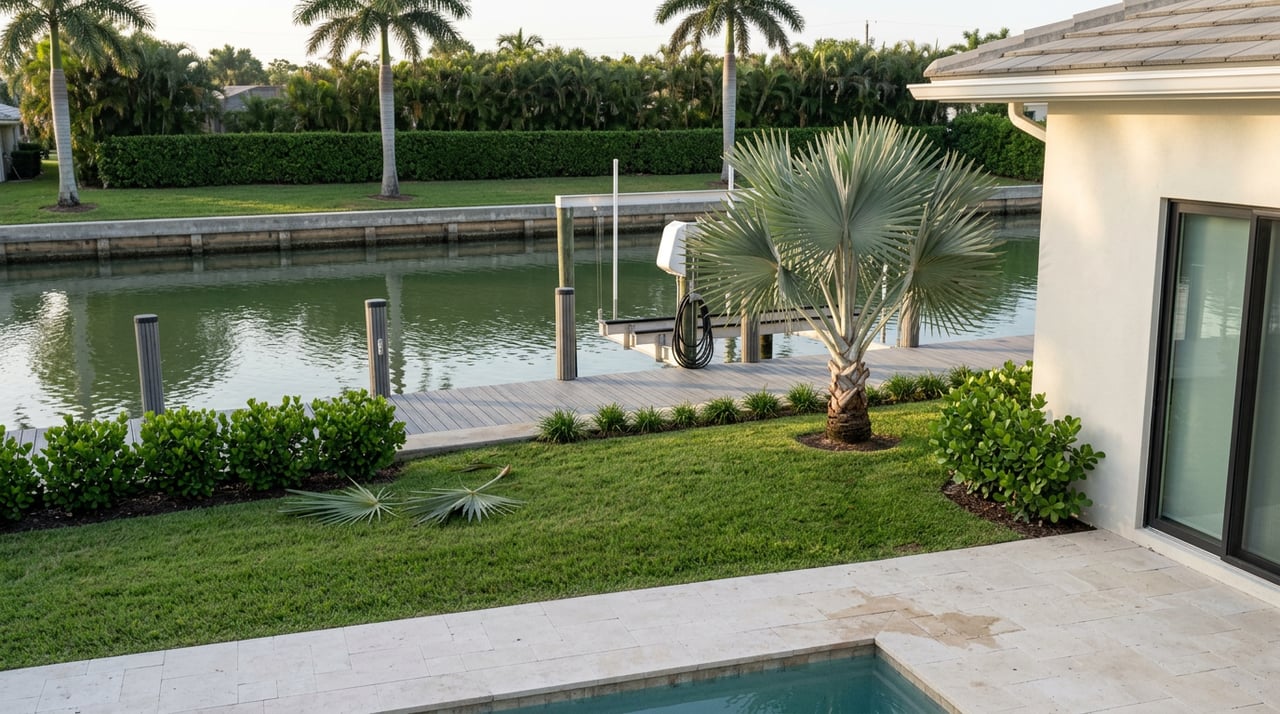
In The Moorings, The Seawall File Sells The House
September 10, 2026
September 10, 2026
A waterfront home in the Moorings sells on the water, not just because of the water. What decides whether a canal-front or bayfront listing here moves in weeks or lingers through a season is rarely the photograph of the dock at sunset. It is whether the seller can hand a buyer's inspector a seawall report, a dock permit, and a current flood zone determination before anyone asks for them. Buyers at this price point have learned to ask. Sellers who haven't assembled the answers are negotiating from behind before the first showing.
That shift shows up in how Moorings homes are already being marketed, in what a failing seawall actually costs to fix, in permit rules that change depending on how wide your canal happens to be, and in a 2024 flood map revision that quietly moved some interior canal lots into a different insurance category than their owners think they're in.
Look at how Moorings waterfront properties describe themselves right now. One listing at Harbour Lights leads with the building's new elevated seawall and new docks, and mentions that owners can lease one of the 35-foot boat slips for $1,000 a year, before it gets around to describing the water view. Another listing at Commodore Club makes a point of noting the unit has never flooded, framing that as rare not just for the building but for Naples generally. A separate single-family listing in the neighborhood itemizes the seawall and dock's age, three years, in the same breath as the roof and the air conditioner.
None of that is accidental. Marine infrastructure has become a headline feature in Moorings listings because buyers have started treating it as one. A dock with no documented history is no longer a charming extra. It is an open question a buyer's inspector will answer one way or another, and a seller who answers it first controls how the conversation goes.
The number that changes how sellers should think about this is the repair cost itself. A full seawall replacement in this part of Florida commonly runs around $1,000 per linear foot, according to marine contractors who specialize in coastal repair work. On a typical Moorings canal lot with a hundred feet or more of seawall, that is not a repair a buyer negotiates lightly. It is a repair that either gets priced into the offer or becomes the reason the offer never comes.
Warning signs are visible if you know where to look: cracking or spalling in the concrete cap, small sinkholes forming behind the wall where soil has washed through a joint, or a section that has started to lean or bow. The seawall at Commodore Club of Moorings Bay needed structural repair work of its own, handled by a Southwest Florida marine contractor specializing in erosion control, which is a useful reminder that this is not a hypothetical risk confined to older, less desirable buildings. It happens in established, well-regarded Moorings addresses too.
For a seller, the practical move is to have a marine inspection done before listing, not after an offer comes in. A buyer's inspector is going to find the same cracks either way. The only question is whether the seller is the one who found them first.
Dock rules in Collier County are not one size fits all, and the Moorings has enough variation in canal width that this matters more here than in a lot of other Naples neighborhoods. Under the county's land development code, how far a dock and moored boat can protrude into the water depends directly on how wide the waterway is.
| Canal width | Dock and boat protrusion limit |
|---|---|
| 100 feet or wider | No more than 20 feet total |
| Under 100 feet | The lesser of 25 percent of the width or 20 feet |
| 60 feet or less, with no seawall or bulkhead | Up to 33 percent of the width, with additional review |
A dock built decades ago under an older version of these rules is not automatically grandfathered the moment a seller adds a lift, extends a finger pier, or replaces a section after storm damage. Any modification can trigger a fresh review under current standards, and a seller who assumes a longstanding dock is untouchable can find that assumption tested during due diligence.
A dock that was compliant when it was built is not automatically compliant today. Every meaningful modification restarts that clock.
The dollar amounts here are small compared to a seawall replacement, but they matter because they show up late if nobody planned for them. The City of Naples charges $100 for a seawall permit, plus a plan review fee equal to 35 percent of that permit cost, due at the time of application. There is also a separate building permit surcharge of one cent per square foot and an electronic permit surcharge of 6 percent.
None of this is expensive on its own. What it does is add processing time to a transaction that a seller assumed was simple. A buyer's financing timeline does not pause for a permit application that should have been filed months earlier. Sellers who confirm that existing dock and seawall work was properly permitted before they list are removing one of the more common sources of last-minute closing delays.
Collier County's Flood Insurance Rate Maps were updated effective February 8, 2024, the first comprehensive revision since 2012, and they remain the maps in effect for construction and insurance purposes today. That update reflected more than a decade of new topographic and hydrology data, not a single storm event, which means it touched flood zone boundaries across the county in ways that had nothing to do with any one hurricane.
The Moorings carries high-risk AE designations in parts of the neighborhood, with VE zones in some Gulf-facing locations. A property that a lender or insurer classified as a lower-risk zone under the old 2012 maps may sit in a higher-risk zone under the current ones, which changes whether flood insurance is mandatory for a buyer using a federally backed mortgage. A seller who has owned the home for years and never revisited its flood zone status may be working from outdated information without realizing it. Pulling a current elevation certificate and confirming the property's zone under the active map is a five-minute check that prevents a surprise for both sides at the closing table.
Before a Moorings waterfront home goes on the market, the file a seller should have ready includes:
None of this replaces good staging or a well-priced listing. It sits underneath both. A buyer who sees this file assembled before they ask for it is dealing with a seller who understands the property, and that confidence tends to move a negotiation forward instead of stalling it at inspection.
Does a newer seawall actually add value, or is it just peace of mind? Both. The Harbour Lights listing that leads with its new elevated seawall is pricing that improvement the same way a renovated kitchen gets priced, as a feature buyers are willing to pay a premium to avoid dealing with themselves.
What if I can't find the original dock permit? Start with the City of Naples or Collier County building records division before you list. A missing permit is a common gap, not a disqualifying one, but it takes time to resolve and that time is better spent before a contract than during one.
Is flood insurance really required if my home isn't directly on the beach? If your property sits in a high-risk zone like AE under the current maps and the buyer is using a federally backed mortgage, yes. Being on an interior canal rather than the open Gulf does not exempt a property from that requirement.
Donna Schrim's background includes hands-on waterfront redevelopment experience, not just years of closing Naples listings, which is exactly the kind of perspective a seawall or dock question benefits from. If you're weighing when to list a Moorings waterfront home, Naples Fine Homes can walk through what your specific seawall, dock, and flood zone file needs before it goes to market. Let's Connect.
Stay up to date on the latest real estate trends.

A thoughtful, results-driven approach tailored to your goals—combining market insight, strategic guidance, and a seamless experience from start to finish.